The Problem
Pharmacovigilance (PV) is a legal obligation, not an option. Every company that markets a medicine or vaccine must collect every reported side effect, process it into a structured safety case, assess how serious it is, and report it to regulators on a strict clock - serious cases within 15 calendar days. Missing these obligations carries regulatory and reputational consequences.
The volume is rising faster than teams can scale. More than 20 million new adverse-event reports were logged worldwide in 2024, up nearly 20% in two years, and the WHO’s international drug-monitoring programme now shares over 35 million case reports a year across 175+ countries. Industry analysts size the global pharmacovigilance market at roughly $10.9 billion in 2026, growing about 13% a year.
Today this work is overwhelmingly manual. For each report, trained staff read a free-text narrative, key in the details, code the medical events to an international standard, assess seriousness and likely causation, draft a case narrative, and quality-check it. The work is repetitive yet demands clinical skill, so it is costly and heavily outsourced to delivery hubs such as India, where millions of cases are processed each year.
The result is a cost-and-risk squeeze. Cost and headcount scale almost linearly with report volume; backlogs threaten reporting timelines; and manual coding varies from one reviewer to the next. As volumes keep climbing, simply hiring more people is neither affordable nor fast enough.
Solution
What Project VIGIL is
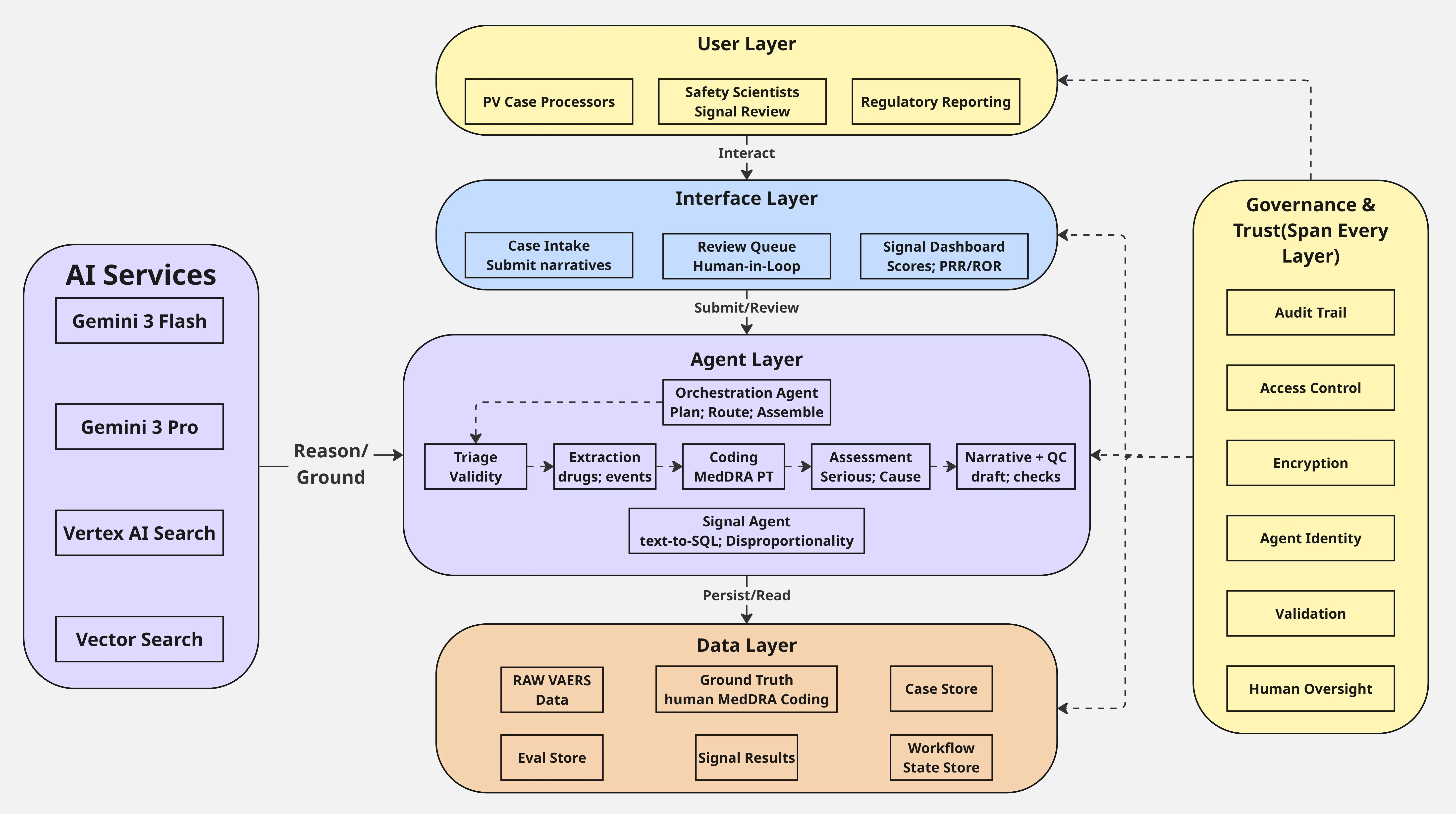
VIGIL is a system of specialized AI agents that processes safety cases end to end, with human experts kept in control. A coordinating agent routes each report through a team of agents that, in turn: screen the report for validity and seriousness, extract the clinical details, code the reactions to the medical standard, assess seriousness, and draft the case narrative - escalating any case it is unsure about to a human reviewer. On top of case processing, a signal-detection capability scans across many cases to surface statistical safety patterns worth investigating.
The defining feature is built-in proof of quality. Every agent decision is measured against the choices trained human coders actually made, so accuracy is quantified rather than assumed. The system is cloud-native on Google Cloud and is designed for regulated (GxP) expectations - audit trail, access control, and human oversight - from day one.
What it Solves
| Dimension | Case processing today | With Project VIGIL |
|---|---|---|
| Speed | Hours of manual work per case; backlogs threaten reporting deadlines | Minutes per case; humans review only the exceptions |
| Cost | Headcount and cost scale linearly with report volume | Effort shifts to exception handling; cost decouples from volume |
| Consistency | Coding and assessment vary between individual reviewers | Standardized, repeatable agent decisions |
| Expert focus | Skilled clinicians spend time on data entry and coding | Clinicians focus on judgment: serious and uncertain cases |
| Assurance | Quality assumed; hard to quantify | Every output measured against trained human coders; full audit trail |
How we will Prove It
- Public data first. We build and validate on the U.S. VAERS dataset - real adverse-event narratives paired with human-curated coding that serves as a ready-made answer key - so we can prove accuracy rigorously with zero data-privacy exposure before any client data is involved.
- Focused, demonstrable scope. A single product family; both an interactive live demonstration of case processing and a larger pre-loaded set powering the safety-signal view.
- Honest about boundaries. Causality assessment is shown as a planned capability, since public data has no definitive answer key to validate it against.
- Evidence the approach works. Early AI adoption across the industry has already cut manual case-processing workload by 30-40%; VIGIL is designed to capture that gain in a measured, auditable way.
Architecture
Functional Flow
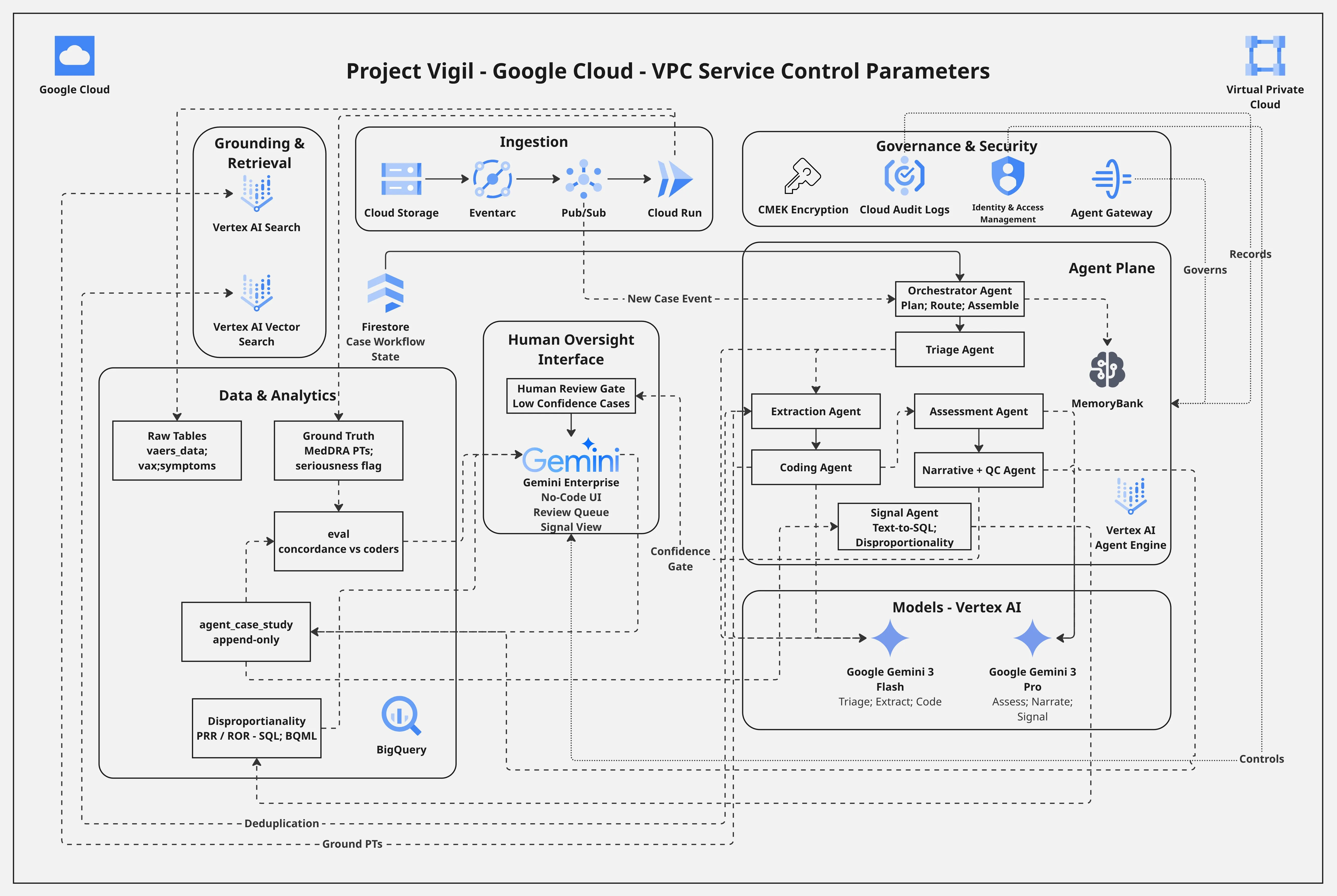
Solutions Architecture
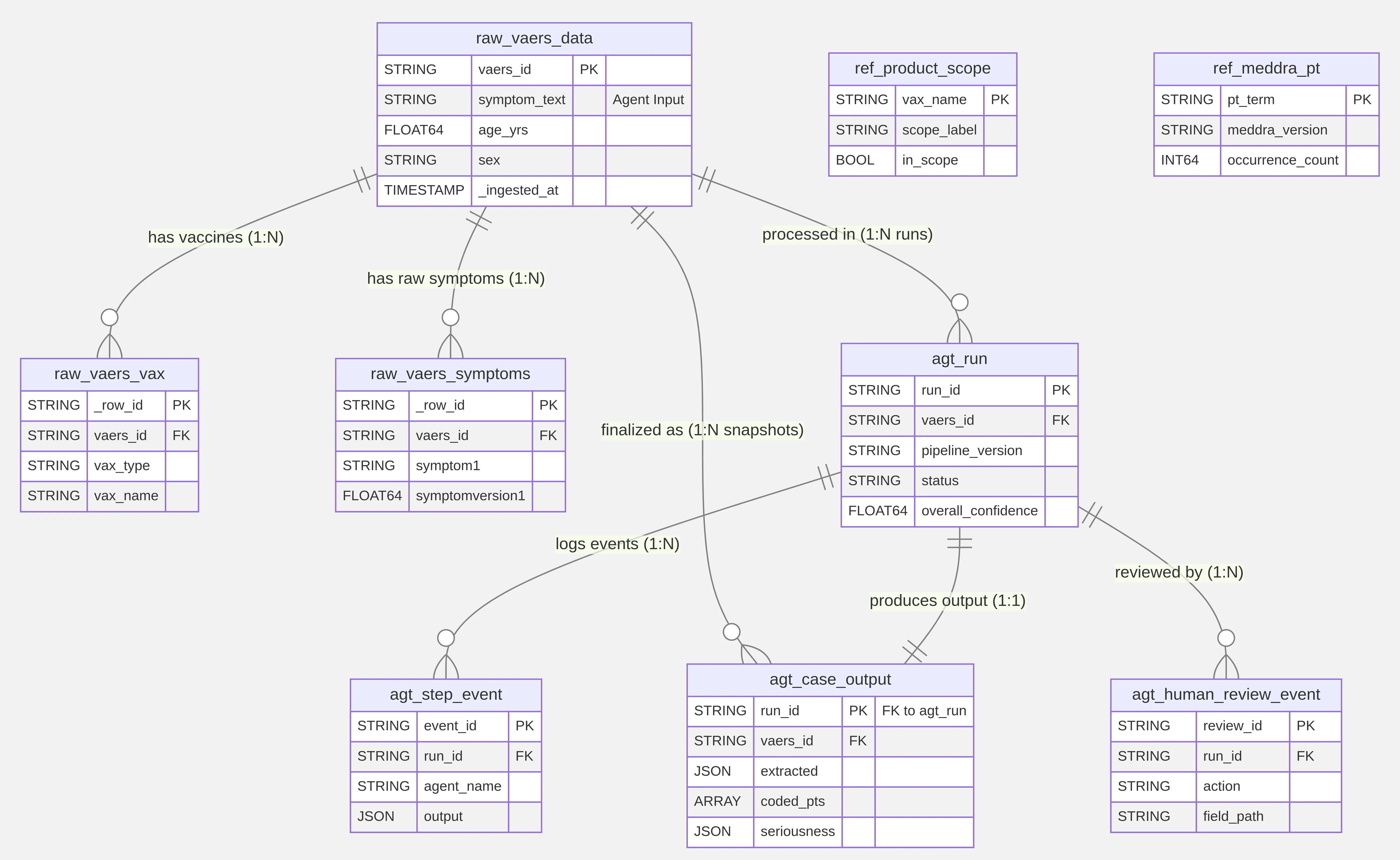
Data Model
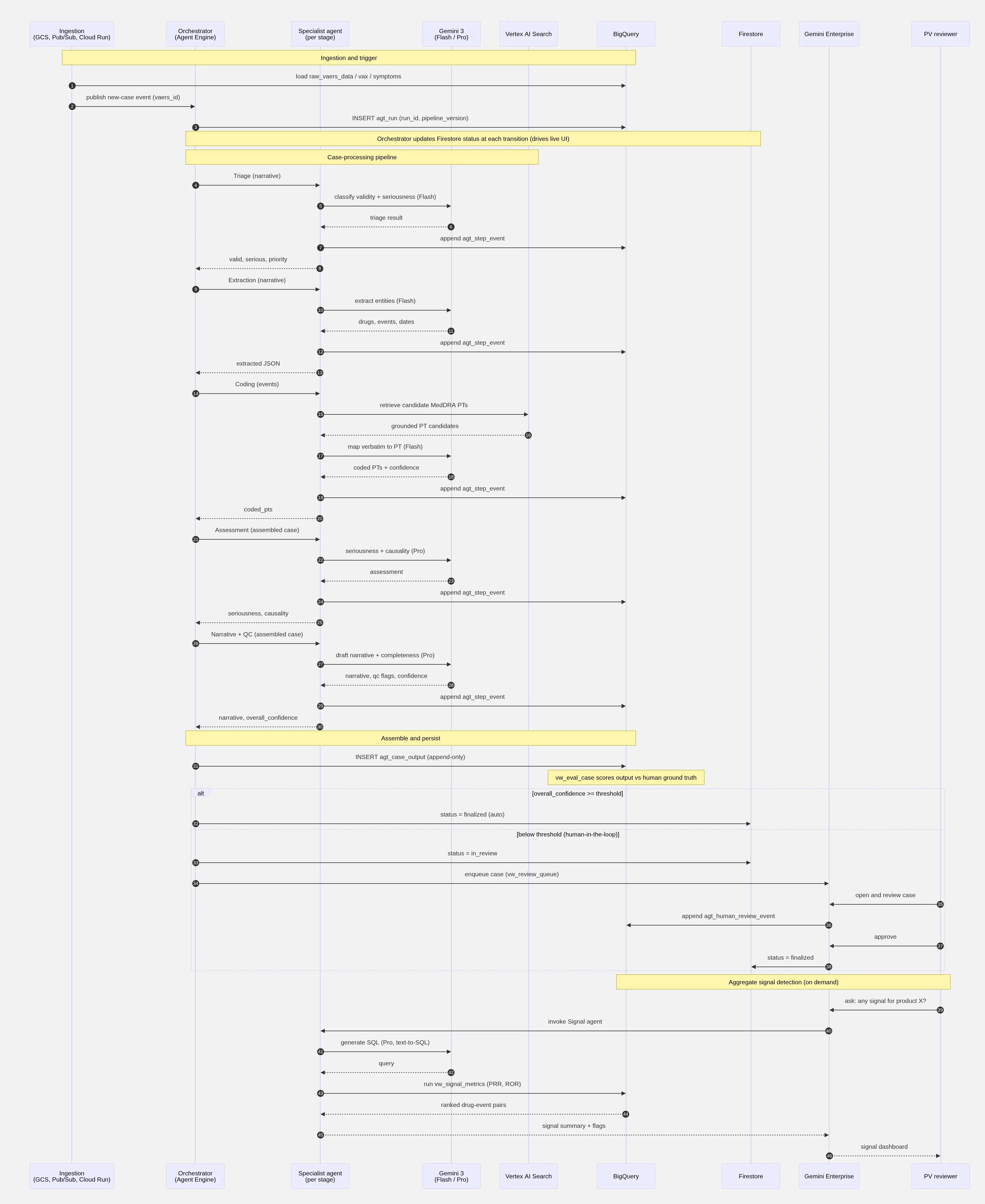
Sequence Diagram