The push, on an island in the Brahmaputra
It was on 2nd May 2026, at the Umananda Temple, a temple that sits on a small island in the middle of the Brahmaputra, that I decided I would visit Kedarnath Dham somehow, and as soon as possible.
The thought arrived while I was standing in the queue for darshan, three hours of it. Through most of that wait I was quietly repeating the Mahamrityunjay jaap, the way I have been doing for as long as I can remember. I have never had a specific reason for it. It is simply what I do whenever I visit a temple, any temple. Once, when I mentioned this to a staunch Brahmin friend of mine, he told me, “You have the liberty of not knowing the power and value of this mantra, and that is exactly why you are able to utter it every time.” He was not wrong.
But coming back to the utterances, that day felt different. I am still not sure what was different about it. This was, after all, an ordinary vacation: a week with my wife across the Seven Sisters. Guwahati was one stop among several, and Umananda was just another visit. We had been to the Kamakhya Temple only shortly before, and honestly speaking, Kamakhya holds far more legend than Umananda for most people, if not for many. And yet it was here that something arrived. It felt as though the idea - the urge, the push - was ushered in through the serene wind, the euphony of the raindrops, and the deep calm of the Brahmaputra.
Why Kedarnath had already been sitting in me
That was not the first time the thought of visiting Kedarnath had come to me. It had never come with that kind of force before, but it had come.
Like most people who are religiously inclined towards Sanatan Dharm, I too was drawn towards Kedarnath after the unfortunate flash floods of June 2013. That may sound like a strange thing to say - how can a person be attracted to a place where thousands lost their lives to a natural calamity? But it is not the tragedy that makes it attractive.
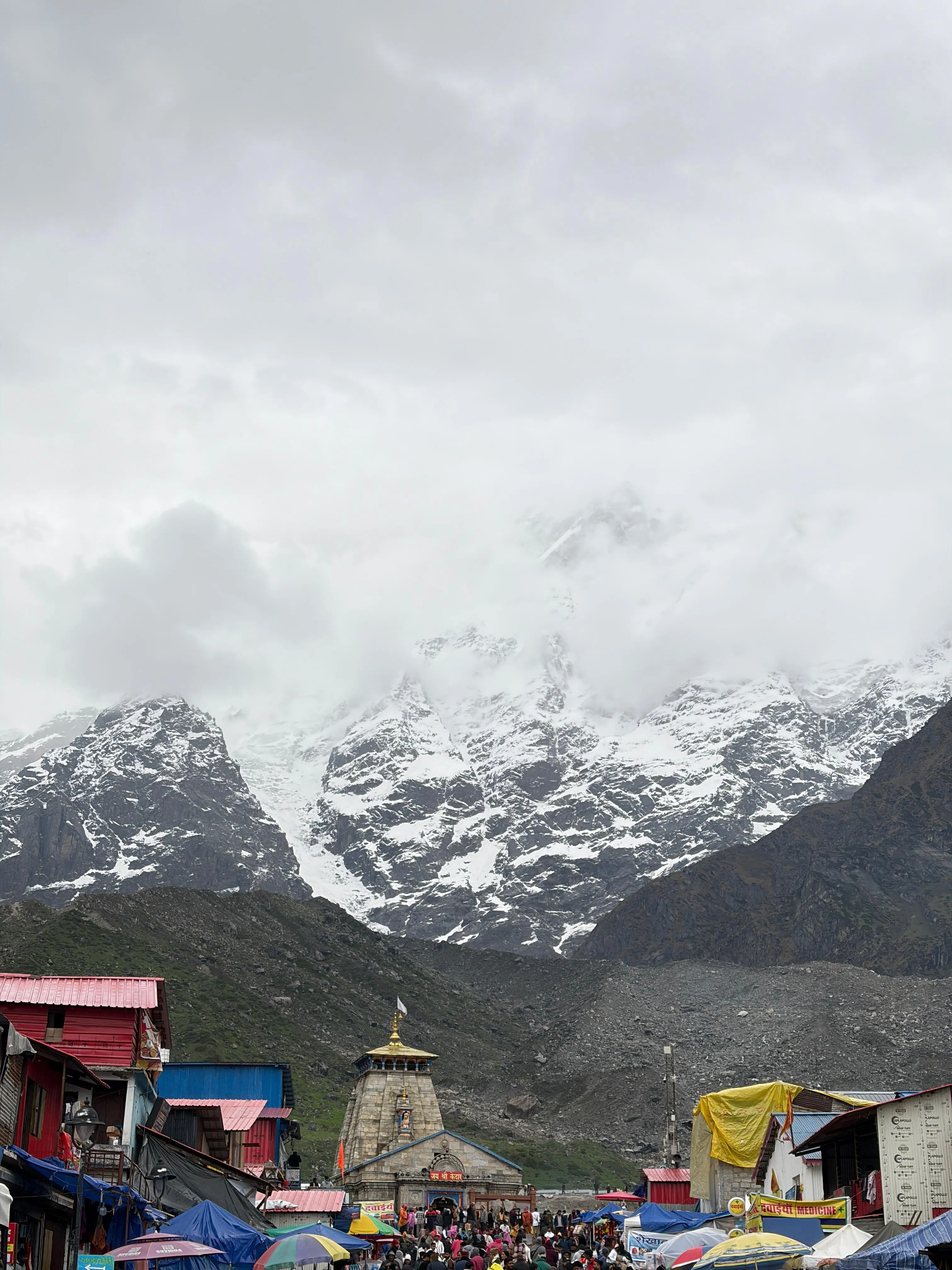
When the rapid melting and heavy runoff breached the banks of Chorabari Lake (Gandhi Sarovar), upstream from Kedarnath, the water came down eroding everything in its path. A massive glacial boulder - now revered as the Bhim Shila - lodged itself directly behind the temple and split the torrent of mud, silt and rushing water around the main sanctum. The 8th-century temple survived. Almost everything around it did not.
It is as if Lord Shiv protected His own house Himself.
Since that incident, the number of pilgrims has only increased year after year. I had read about it, watched the pictures and the news reports, and somewhere in all of that, I had decided I wanted to go.
But the traceability goes further back
I think the real timestamp lies much earlier in my life.
I have felt a strong bond with Lord Shiv since childhood, and the reason for that is my Mother.
I was born on the day of Hartalika Teej, a major festival on which women keep a strict waterless fast (nirjala vrat) praying to Lord Shiva and Goddess Parvati for a long and happy married life. My Mother used to tell me that during labour she was asked to drink water and break her fast, because the delivery was turning difficult. I was born at 7:43 in the evening. She never broke her fast.
I can still remember the pride on her face every single time she narrated this. She would say that I was a direct gift from Lord Shiv to her, and that this is why I carry some of His features. (Mothers have strange ways of reasoning out why their child is special, I suppose.)
I remember her telling me this story for the first time when I was around ten years old; I am sure she must have told it many times before that, but ten is where my memory threshold begins. The moment I heard it, I felt that child-like flutter of butterflies in my stomach, and, being a naive kid, a small sense of pride began to grow in me. I remember walking up to the wall calendar that had an image of Lord Shiv on it, and simply standing there, blushing.
The next day I told my school friend about it(I only had one friend) and he said, “My Mother tells me Lord Hanuman has given me to her.”
That did not demotivate me, and it certainly did not stop me from building a strong internal bond with Lord Shiv. That was, essentially, the entrance - the aagman of Lord Shiv in my life.
Kashi
Fortunately, at around seventeen, I moved to Kashi for my higher studies and competitive exam preparation.
Kashi holds a very important place in Sanatan Dharm. According to the Skanda Puran, Kashi rests above the physical earth on Lord Shiv’s trident, held secure and sacred outside the ordinary realms of time and destruction.
I have always felt I was destined to be there. In those days, people from my friend circle went to Delhi or Kota, or stayed back in Patna, my hometown, to prepare. Somehow, I went to Kashi.
Over those two years, my connection with Lord Shiv deepened. I spent all my free time on the Ganga ghats, talking to both kinds of people, those who remember Lord Shiv for their business, and those who are devoted to Him. I loved listening to stories from Indians and foreigners alike about how Kashi, or Lord Shiv, had changed their lives. (There are a great many foreigners who settle in Kashi - there are entire colonies of them, just for reference.) This was also when I began to read more of the ancient texts, sitting in the libraries of Banaras Hindu University and Kashi Vidyapeeth.
By that time, whenever I felt angry, happy, distressed or sad, the first two words out of my mouth were Hey Bholenaath.
So the pilgrimage to Kedarnath was not a single day’s thought. It was, I think, a path my whole life had been walking on already.
Finding three people
It was mid-May 2026 when I started planning.
The first person I asked was my lifelong partner, my wife. I already knew she would say no. She pointed to the physical strain it would involve, which was completely fair and understandable. But she also told me not to do it as a solo trip, for obvious reasons: I have no physical activity in my life whatsoever, and I work from home, sitting long hours in front of my laptops.
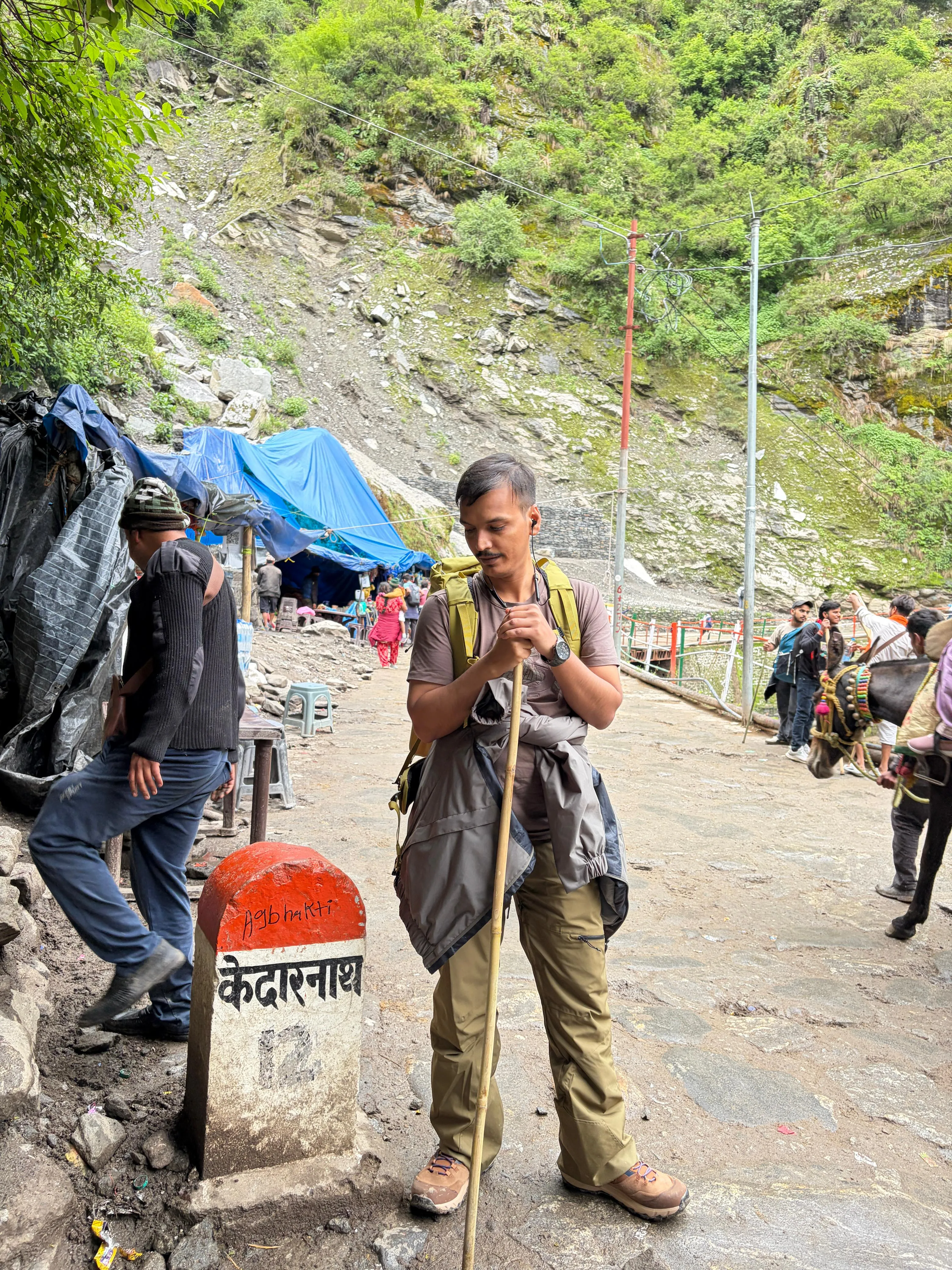
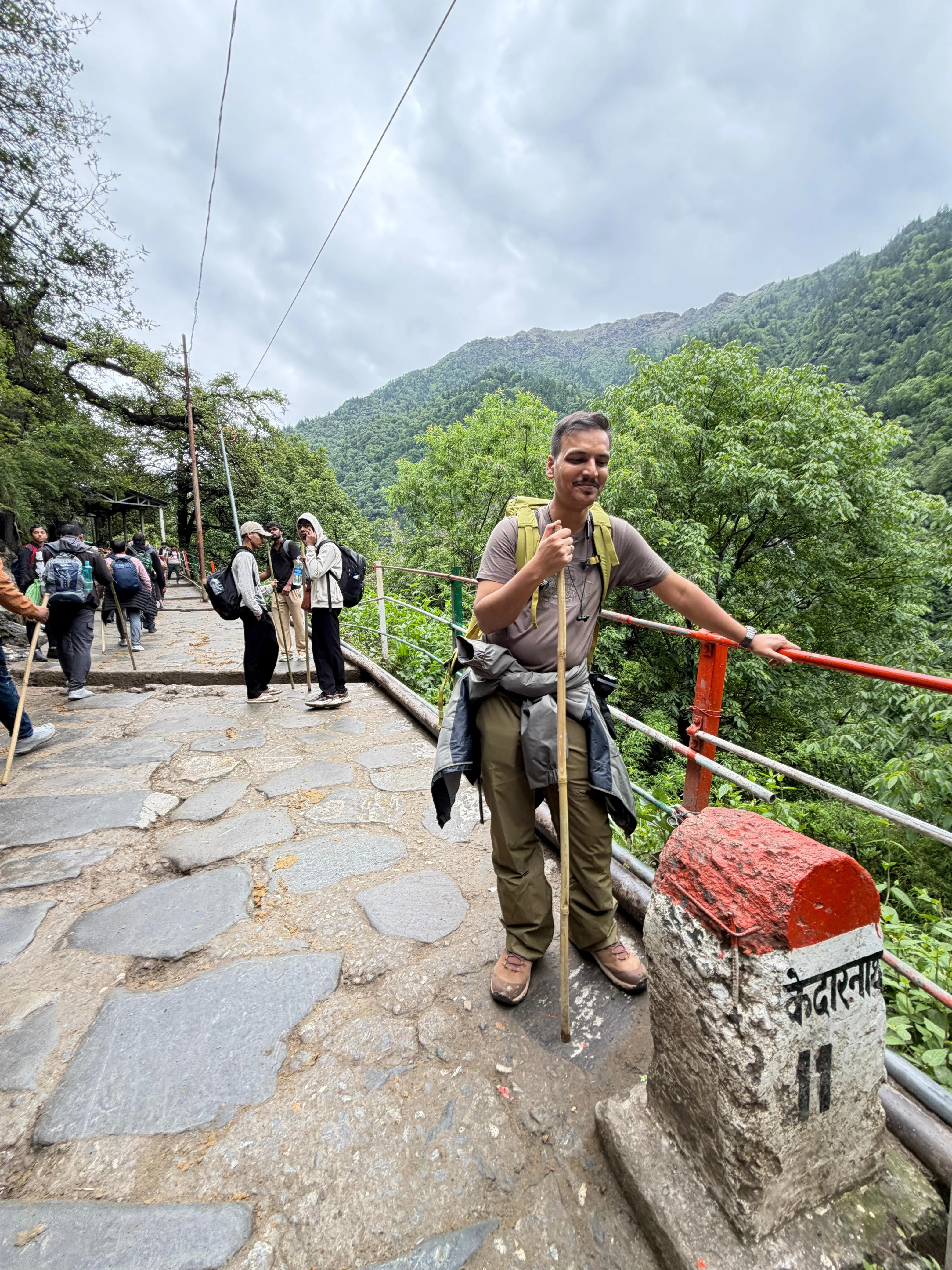
From a standard trekking perspective, the Kedarnath trek is generally considered moderately difficult. It is about 16 km one way (in practice, closer to 22 km), a continuous uphill walk that climbs from 1,982 metres to 3,583 metres above sea level. For someone like me, going alone would have been difficult - physically, and morally too.
So I needed to find someone.
I asked my younger brother, who is religiously inclined towards Sanatan Dharm, but he refused. He said he did not feel the calling.
Then I asked a senior from my Kashi days, who is also a very good friend. He already had a plan to visit Vaishno Devi around the same dates and asked me to join him and his friends instead. But the urge I felt was specifically for Kedarnath, and I could not let it go. So I said no.
I have never been a people’s person - I have perhaps three or four friends, and I had already calculated that none of them would come along, either because of faith or because of unavailability. For a few days it looked like I would simply not be able to go this year.
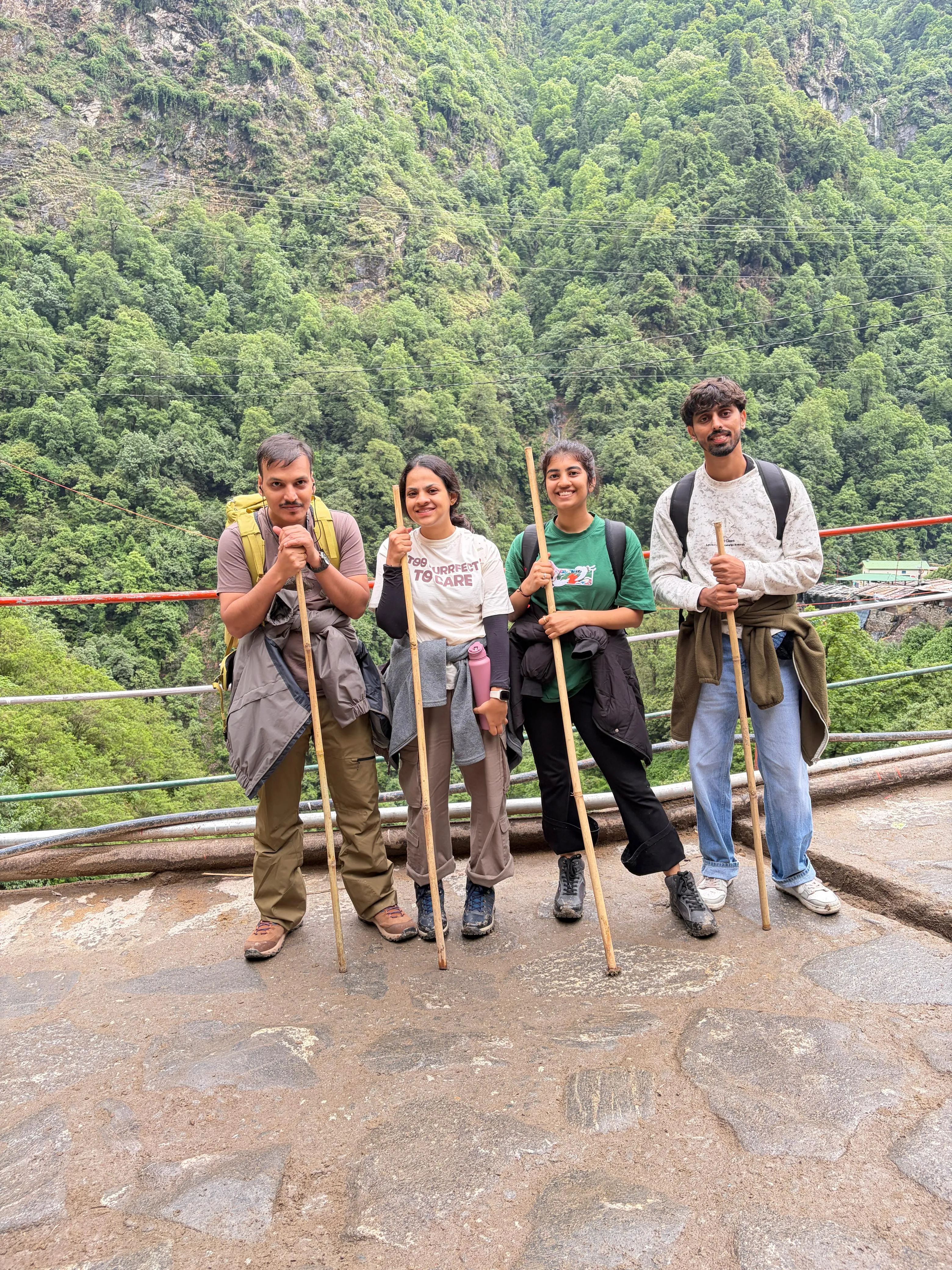
Then, on 17th May 2026, I asked two junior colleagues from office. They are quite a bit junior to me, but we had been working together for close to a year and had built a strong bond. After some back and forth, they agreed. We then convinced one of their friends as well.
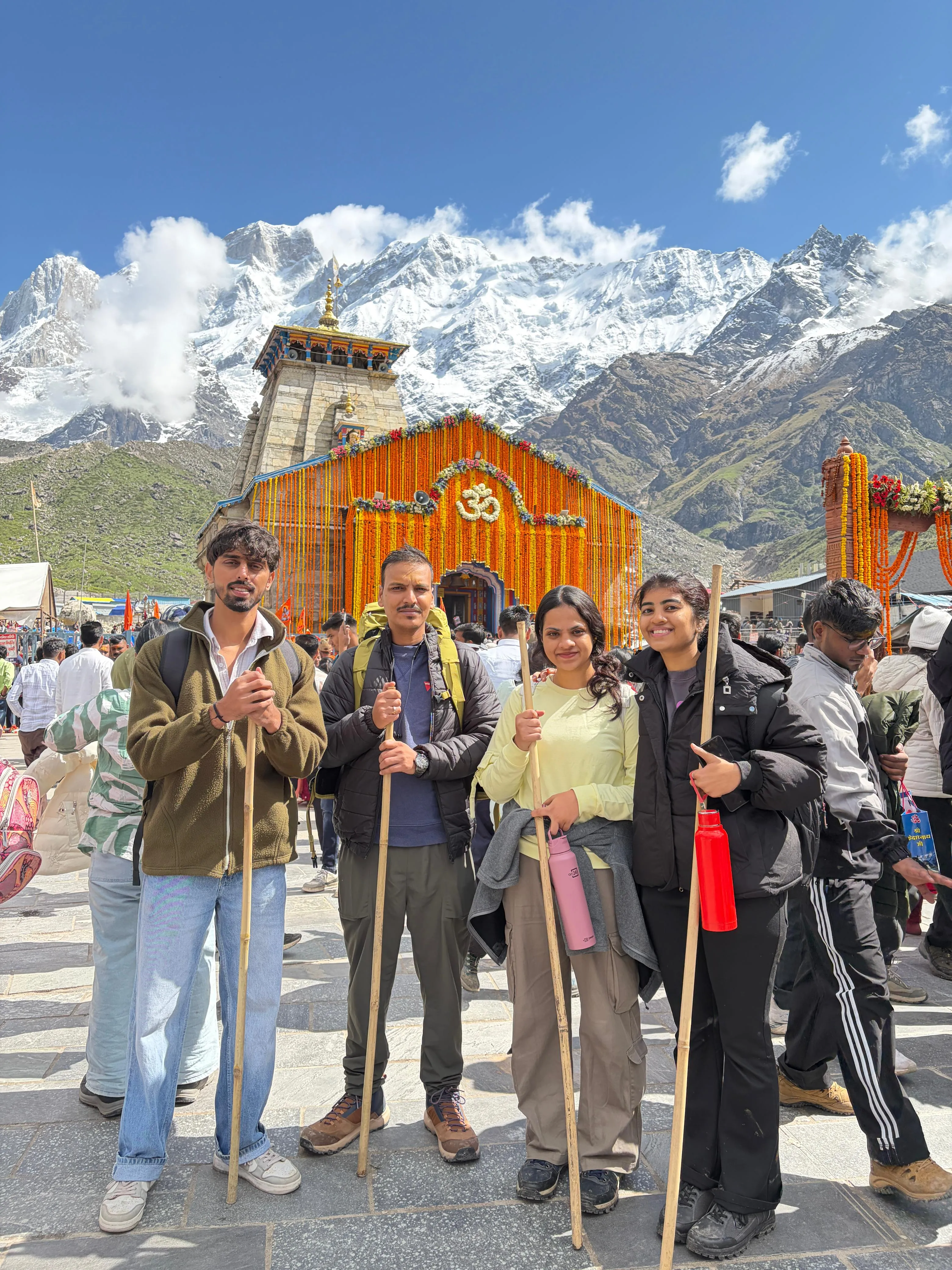
And then there were four.
The two weeks before
19th May 2026: WhatsApp group created, all documents collected for registration. By the end of May, every booking was done Yatra registration, flight tickets, cab, hotels. Everything.
The journey was set to begin on 12th June 2026, on an early morning flight from Bengaluru to Dehradun, from where we would continue by cab for the rest of the pilgrimage.
Those two weeks of waiting were full of anxiety. I became that child again, manifesting what I would do when I finally met my Hero, my Lord Shiv. What would I say to Him? What would I ask His enlightenment for? How would I pray around Him? How would I greet Him when I first ses Him and how would I say goodbye when leaving?
And running underneath all of it, the other set of questions: what if I could not make it to the top, given my zero physical activity? Would I even be able to take care of, and be responsible for, three colleagues who at that moment were the best people in my life? What if someone fell ill?
I started watching YouTube shorts, reading travel blogs, going through other people’s experiences, the dos and the don’ts and the more I read, the more agitated I became. During the first week of June, the yatra had to be suspended for a few days because the weather turned very bad. And since this was peak season, just before the holy month of Shravan, the crowds were unbelievable.
Every day I followed the news. Every day I called my cab provider, and every day he assured me that everything was fine - just trust Bholenaath.
Then came the night before the travel. I could not sleep. It was not that I did not try; it was simply the excitement of a small child, and not of a responsible adult with a hectic journey a few hours away.
12th June
We left for the airport early in the morning and landed in Dehradun by ten, after a three-hour flight from Bengaluru. And then we met our cab driver.
Our driver was the best storyteller I have ever met. Through the entire drive he narrated the history of that beautiful land of Uttarakhand, most of it circling back to Kedarnath. We were fascinated by him. Not once were we bored. All along the way, he made sure we absorbed the history and context of every place we passed. He narrated, for instance, the entire story of the Tehri Dam - the highest dam in India, built on the Bhagirathi.
And as we drove alongside the Bhagirathi, I sat watching the river through the car window, with the wind talking to me directly and holding my life up in front of me. I have spent my entire life beside this water without once asking where it comes from.
Patna, where I was born, sits on the Ganga. Kashi, where I went at seventeen, sits on the same Ganga - except that there she turns and flows north, uttaravahini, as though pausing to look back at the place she came from. And now I was driving along the Bhagirathi, on my way towards the Mandakini.
For years I had carried these in my head as three separate rivers. They are not. The Mandakini comes down past Kedarnath and gives herself to the Alaknanda at Rudraprayag. The Alaknanda meets the Bhagirathi at Devprayag, and only after that meeting is she called Ganga at all. Which means the water I grew up beside, the water I sat next to on the ghats for two years, talking to strangers about their lives, had already touched Kedarnath long before it ever touched me.
I had the whole thing backwards. I thought I was going to Kedarnath for the first time. In truth, Kedarnath had been coming to me: past Devprayag, past Rishikesh, past Kashi, past Patna, arriving at my city each morning without announcement, and I had simply been calling it a river.
The direction is the point. All my life the water travelled towards me - downhill, without effort, without being asked. Now, for the first time, I was moving against it. Every kilometre of that road was a kilometre the river had already covered in the opposite direction. Perhaps that is what a pilgrimage actually is: not the covering of distance, but the reversal of it. You spend your whole life receiving something, and then one day you decide to go and stand at the place it has been coming from.
And there is a name sitting inside all of this that I could not ignore. The river running beside our car carries the name of Bhagirath - the king who stood in penance for years so that Ganga would agree to come down to the earth, and whose effort we still invoke whenever we call something a Bhagirath prayatna. When she finally came, her descent would have shattered the ground, so Lord Shiv took her into his matted hair and released her gently. Every drop that has ever passed Patna passed through his hair first.
My Mother believed I was a gift from Lord Shiv. Sitting in that car with the window down, watching the Bhagirathi keep pace with us and then fall behind, I thought: perhaps the gift had been flowing past my city all along, and it had taken me thirty-odd years to walk upstream and say thank you.
22 kilometres
We stayed the night at the hotel and began the trek on 13th June at around 5 AM.
The first four kilometres went by in just under an hour. Naively, still carrying the childish mind I had been carrying around for weeks - I did the arithmetic and arrived very happily at a conclusion: seven hours, maximum, at this pace. I was either unaware of the reality or deliberately ignoring it. Excitement has a way of interfering with arithmetic when you are on your way to meet someone you have waited your whole life to meet.
Then the road began to rise properly, and the old questions came back.
They had been waiting for me. Will I make it to the top? Can I be responsible for three people if something goes wrong? What if one of them falls ill? Short breaks pushed the questions away for a while, and so did conversations with strangers on the path but they never actually left. They only moved to the back of my mind and stayed there, walking at my pace.
I was careful not to check on my body. That was deliberate. I was afraid that if I honestly took stock the legs, the breath, the shoulders - the answer would break me.
And while I was busy avoiding that, a second thought began running parallel to the first: why is there fear this close to Him? This should not be happening. Not here. Perhaps it was only my brain doing what it always does, demanding a rational explanation for something. But even the demand frightened me, because if I reasoned it all the way down to a conclusion, the conclusion might not be the one I had spent all those weeks manifesting.
The two thoughts were still arguing with each other when I saw an old lady fell.
She was some way ahead of me. A pony had collided with her on the path, wet from the rain, and she had gone down. By the time I got closer, her family and the pony owner’s people were already deep in a heated exchange.
But for one very brief moment I noticed something strange. The old lady herself carried no anger. No complaint. She sat there with a smile and something like contentment on her face, and she was the one holding her own family back from the argument. Sab Bholenaath ki kripa hai, she said.
I think that was the moment the rational side of my brain quietly took a backseat. I moved ahead.
It was somewhere after Rambara, with eight or nine kilometres still to go, that my body began to give up.
The backpack changed character first. Until then it had been an object I was carrying; now it became a thing that was carrying me downwards. The straps began to press into my shoulders and pull, steadily, in the exact direction I was trying not to go.
I could see the tiredness on my colleagues too. But they kept walking. I still do not know whether that was because of me, or because of their own faith.
And then my brain sent me a signal I did not expect from myself: ask the pony owners along the way whether anything is available.
The battle started again, louder this time. One part of me stood on a principle I have held for a long time that I would not do this climb on a pony. The other part immediately turned the question outward: then what about all the people who are on ponies? What does that make their faith?
And somewhere inside that back-and-forth, the real question seeped in. What exactly is Faith?
If faith is your bond with Him, why should it matter where you form it? Why must you travel to one specific place to prove a bond? If you believe in Him at all, then you also believe that the entire universe is His creation. He has never asked anyone for this.
But the moment I thought it, the counter-argument stood up. There are places that carry energy - positive and negative, and they are not the same. You feel different standing in them. And if that is true, if the place genuinely does matter, then surely how you arrive at it should not.
Both sides were still on their feet when one of my colleagues called out: “Himanshu, here is a shortcut, let’s take it.”
I took it. I let one side of my brain win the argument, and I have not settled it since.
What followed was a long stretch made almost entirely of short breaks which grew longer and more frequent the higher we went - some conversation among ourselves, and a great deal of conversation within myself. There were moments of anger and frustration too: the palkis, the ponies, the pithoos, all of them cutting across the path, forcing us to stop and step aside again and again.
And then, finally, Kedarnath Base Camp.
From there, He was one kilometre away.
I still do not know how to explain what that last kilometre did to us. It refused to end. And it was not only me, my colleagues felt exactly the same. About two hundred metres in, the top of the Temple came into view, and from that point the whole arrangement turned almost absurd: the closer we walked, the further He seemed to move. I remember thinking, quite literally and without any irony, that He was testing us.
And then my body stopped negotiating.
It went completely black around me. The dizziness came, and with it that particular internal heat that tells you a fever is on its way. I kept walking. I had no confidence about how much longer I could keep doing it, only that stopping, here, was not something I was willing to do.
I do not fully remember covering the last part of it. What I remember is reaching the steps of the Temple and finding that I could barely stand.
I stood there for a moment. And I told Him: I can’t take it anymore.
Then I turned and went to the room, which was very close by. I took a 650 mg paracetamol. I called my colleagues, who were about to reach, and told them I was going to sleep and would come to the Temple later. They tried to convince me, the Aarti was about to begin, everything had been decorated so beautifully, I should come even for a few minutes. I couldn’t.
I went into a deep sleep, a few hundred metres away from the one place I had spent my whole life walking towards.
So close, and yet so far.
Was my faith weak?
Darshan
I woke up at around 9 PM. The fever had gone. I felt strangely fresh, as though the last kilometre had happened to someone else.
My colleagues came and told me about the Aarti - what it had looked like, how the Temple had been lit. And while I listened, what I mostly felt was guilt. I was only half listening. The other half of me was busy running myself down: you waited your entire life for this, and when the moment finally arrived, you slept through it.
Then I freshened up and walked to the Temple. Alone. I wanted the first moment to be only mine.
There were not many people left on the raised platform where the Temple stands. The Aarti had finished a couple of hours earlier and most of the crowd had gone back.
And standing there, I felt a silence. Not outside - outside there was still movement, still sound. The silence was internal.
I tried to hold my thoughts to that one moment, and I struggled, because every manifestation I had built since childhood was circling me, exactly the way the clouds circle the mountains standing around Kedarnath. Close enough to touch, and impossible to hold.
I prayed the way I always pray, with the Mahamrityunjaya mantra. Except this time I was not keeping the count.
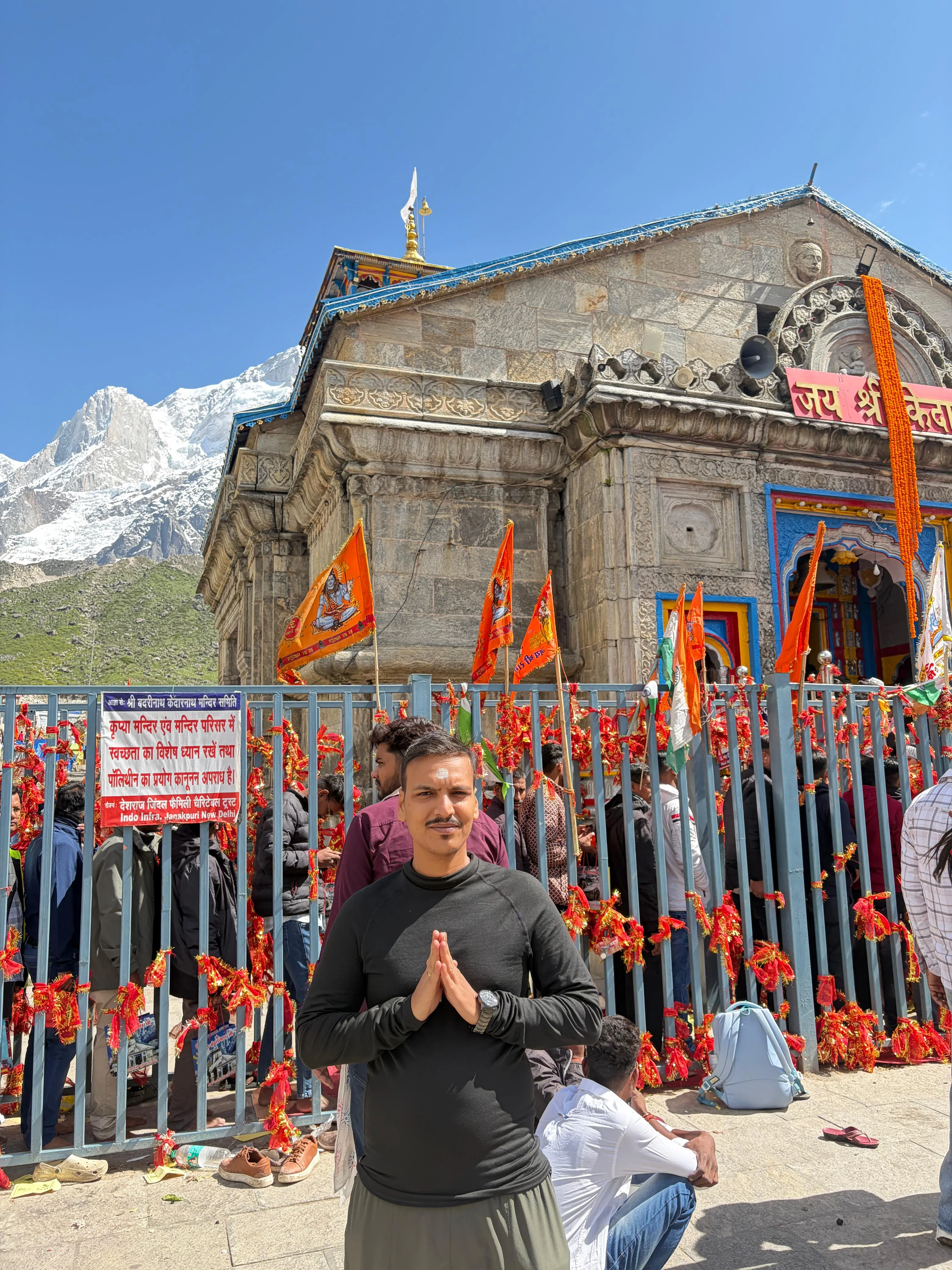
You cannot go inside the Temple at that hour. The gates open at 5 AM for Sparsh Darshan and close at twelve noon. But you are free to be around the Temple whenever you want. So I simply stood there and stared at it.
And a smile came on my face, the same smile I had seen a few hours earlier on that old lady on the path, with the same contentment sitting behind it. The blushing of that ten-year-old boy in front of a wall calendar came back to me, decades late and completely intact.
Kashi began to pass through me - the ghats, the winters, the strangers and their stories. My earlier trip to Rameshwaram came, took a corner of my mind, and quietly settled there.
And all that preparation - every conversation I had rehearsed, every question I had lined up during those two anxious weeks, None of it happened.
I did not demand a blessing. I did not ask Him why certain unfortunate things had happened in my life. I did not ask for the meaning of life, or of faith, or any philosophical question at all. After a very long time, my mind was pure. Free of ask. Free of question. Just free.
What I did instead was watch, and imagine.
I thought about the Pandavas arriving in these mountains looking for Him, carrying a guilt they could not put down, hoping to be forgiven. I thought about Bhim catching hold of Him when He had taken the form of a bull and begun to disappear into the ground, holding on by the tail and the hind legs. I thought about Him sinking into the snow and the earth with only the hump left exposed. I thought about Adi Shankaracharya arriving here in the 8th century and raising the Temple again.
Every thought in my head that evening was about Him. Not one of them was about me. The whole of it belonged to the child’s Hero, and there was not a trace left of the argument I had been having with myself for twelve hours on the way up.
At some point I noticed there were tears in my eyes. I still do not know what they were for.
After a while I got up and started walking around, talking to the shop owners and to the aghoris - exactly the way I used to on the ghats in Kashi. There was nothing remarkable about it. It is what I do at every religious place I go to, and I have been doing it for years.
We stayed there for two nights.
We did the Sparsh Darshan, and it was not easy at all. Six hours in the queue. Minus three degrees. Nowhere to sit, the line was a narrow alley made of metal guardrails, and you stood in it, and that was that. Six hours, to physically touch the exposed hump of Him in the form of a rock.
And this is the part I still find difficult to explain. It did not tire me. Not the way the climb had. No fever. No agitation. No argument running in the background. Yes, it was tiring in the ordinary sense - six hours standing in that cold is tiring for anybody but it took nothing out of me. By then I was already content.
Then, at around 10 in the morning, we took His leave and began the descent. Eight hours later, we were back at our hotel.
Coming down
On the way down, the argument in my head started up again. But this time, the side arguing for faith had come with some arsenal.
It was never manifestation or faith.
It was faith that began as the manifestation of a naive child and was then reinforced, again and again, by the experiences of a life, alongside a few more manifestations along the way. And those manifestations keep returning, which means they must be coming from some source. I think I know what the source is. It is the contentment I feel, that very specific quiet, whenever I utter His name.
If, in any situation at all, saying His name gives me calmness and leaves my mind clean of noise, then I am willing to call that Faith. And I think that is exactly what a bond is.
We can, for the sake of intellectual debate or of some broader argument about the meaning of life, keep discussing whether a higher power exists. That discussion is not going to conclude. But at the end of the day, what matters is how the thing affects us. And if we receive even a slight positive signal from it, I think we should follow it the way that ten-year-old followed it - through manifestation, or through faith, it does not matter which.
Kedarnath will always be special to me. Not because it was the most physically difficult thing I have done, but because it handed me a method, a way of arriving at the likelihood function which, applied to everything I was already carrying, leaves behind a cleaner posterior over the events of my life.
And the best part is that it was already there. All of it. It had been sitting with me since I was ten years old, standing in front of a wall calendar.
So it is not manifestation or faith. It is a cycle. A continuous one. And it stops only when the soul departs from this body.
One last thing.
I have recited the Mahamrityunjaya mantra in every temple I have walked into since I was a boy, without ever knowing why I did it. My friend told me once that not knowing its power was exactly what allowed me to say it so freely - every time, without weighing it. He was right. And for most of my life, I was grateful for that liberty.
That liberty does not last. Sooner or later, every one of us finds out precisely what the mantra is for.
I think that is the real reason I could not let the thought go after Umananda. It was not a plan. In the beginning it was not even a decision. Something had been placed in me a very long time ago by my Mother who kept a waterless fast through a difficult labour and refused to break it, and it had been waiting patiently all these years for me to walk twenty-two kilometres uphill and set it down.
That is why I asked for nothing that evening. There was nothing to ask for. I only wanted to stand there and be seen standing there, the way a ten-year-old stands in front of a wall calendar and blushes, hoping to be looked at by someone he loves.
She used to say I was a direct gift from Lord Shiv to her. On that platform, in the cold, with the clouds moving around the mountains and no count left to keep, I understood that it also worked the other way around and that I had climbed all this distance simply to say so.
Comments
No comments yet.